
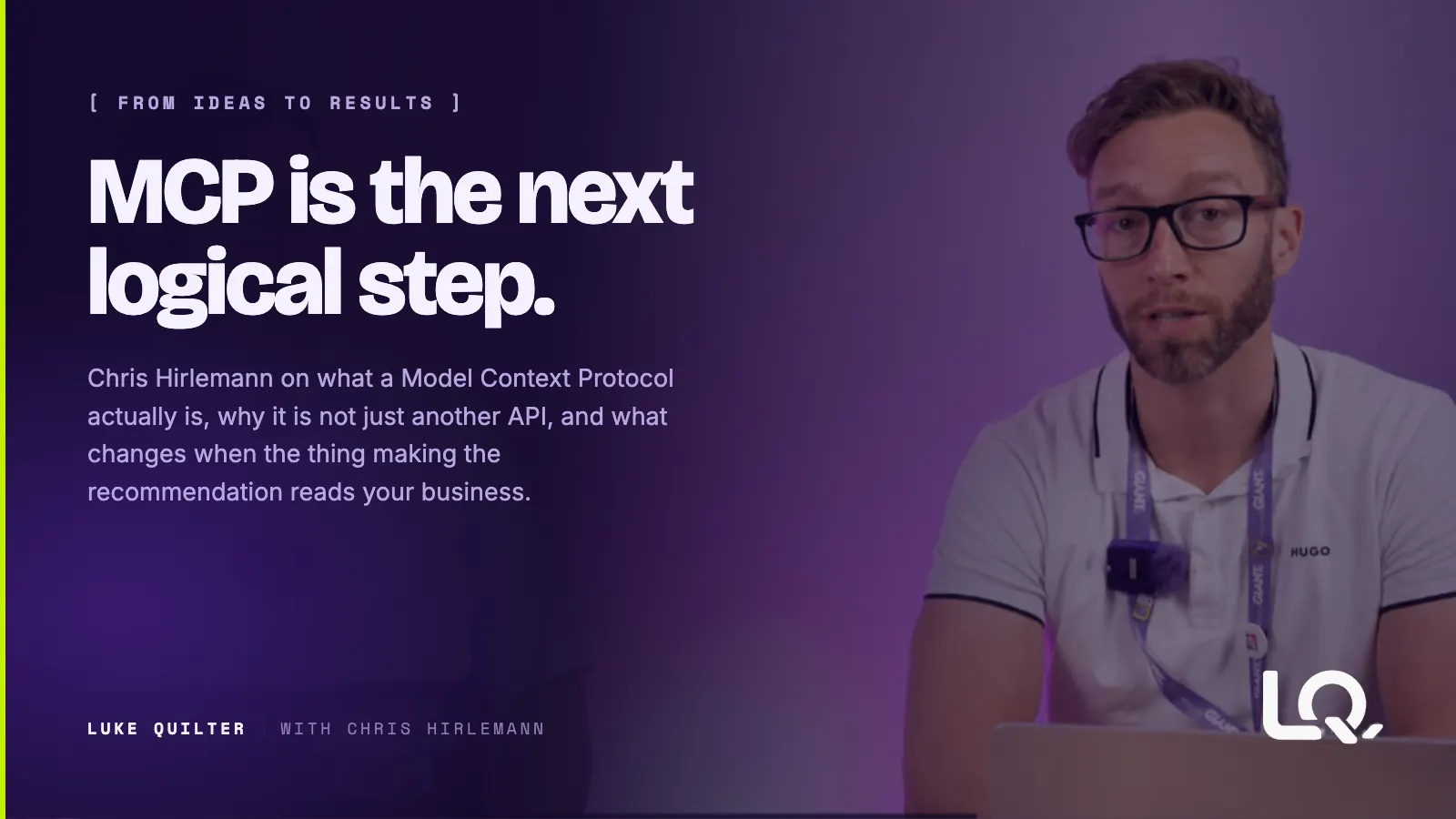
On the latest episode of From Ideas to Results I was joined by Chris Hirlemann from our Sleeping Giant Media Data and Performance team, to dig into what is happening in the world of data.
The main topic was MCPs. Which is, as I put it to Chris on the day, another three letter acronym to add to the growing list. So the first question was the obvious one.
What actually is an MCP?
Chris’s answer was refreshingly plain: it is very much like what we would once have called an API.
“It’s essentially giving access to a whole bunch of information, normally structured information. You might use that, for example, to go into Google Analytics and get your performance data. But you could also look at things like how are the admin settings set up.”
MCP stands for Model Context Protocol. Most businesses, and particularly data providers, are now making things available via MCP, and they are built specifically so that AI can interact with systems in much the same way an API would have.
The opportunity is also the key feature: it is open
I asked Chris what the opportunities and implications are. His answer was that the opportunity and the feature are the same thing. It is open. It opens the door for you to use LLMs and agents to talk to your data.
Connecting one up is normally quite easy. A lot of them are just providing the API keys and tokens, and you can go into something like Claude or ChatGPT and say, here are the tokens, now I want you to be able to interact with that. Sometimes you set a phrase or trigger word, and then you can ask it to go and pull the performance for a set of accounts. It comes back with a little table.
The bit that gets interesting is the next question you ask it.
“You can ask it questions like, what are the next five big things that I could do on these accounts to drive impact? And it’s really quite impressive in so many ways.”
Why this is different to an API
This is the part I think leadership teams should pay attention to, because it changes who in your business can get at your own data.
APIs are technical. You have to be experienced in setting them up, you have to understand how all the elements work, and there is usually huge documentation to wade through. That has always meant a queue: the people with the questions are not the people who can get the answers, so everything routes through a developer or an analyst.
MCPs are designed to work with agents. So as Chris put it, you just need to know how to ask the right questions, put the right prompts in, and frame it correctly. That is a very different skill, and it is a skill far more people in a business already have.
It is the same shift I keep coming back to when I am speaking at events: the constraint stops being technical access and starts being the quality of the question you ask. That is a good problem to have, and a much more coachable one.
The other side: making your business visible
The flip side is the bit most businesses have not thought about yet. It is not only about you consuming other people’s data. Businesses can start creating MCPs of their own information, to increase their visibility.
Chris painted the picture better than I could:
“Imagine a future where you can go to Alexa and say, Alexa, I need dinner. I’ve got a budget of twenty pounds and there’s two of us. Can you give me the options? And then the next thing you say is, can you order that for me?”
That is the whole discovery and purchase journey, done without a browser, a search results page, or a website visit. If your product, your availability and your prices are not readable by the thing making that recommendation, you are not in the shortlist. This is exactly the same argument as marketing to an agent rather than a human, just applied to your data rather than your content.
Is this the standard, or an early experiment?
I put it to Chris that a few providers on the data side have already enabled this, and asked whether his expectation is that this becomes the standard and everyone has one.
“Yeah, I can’t think of many systems that we use that don’t either have an MCP already or in the process of building one.”
That is worth sitting with. Not a handful of early adopters. Close to all of the tools a modern marketing and data team touches.
Can you build one yourself?
My last question was the practical one. What do people actually need to do, and is it possible to build these themselves?
Yes, but go in with your eyes open. Building an MCP is very similar to building an API. You are building structured documents and ways of engaging with those documents. It is complex, you have to think it through, and you have to do it properly.
The key part is the instructions. Chris compared it to the knowledge file you would create for a custom GPT: here is all the information that is available, here is how you can access it, and here are some example questions you could ask to get particular answers. Get that right and the LLMs will figure out the rest on their own.
And on who should bother:
“If you are a provider of a service that is the sort of thing that people might ask AI, and pretty much they’re asking AI everything, if you sell a product, making that product visible in as many ways as you possibly can. You’ve probably got feeds, you’ve probably got a website that explains it. MCP is the next logical step.”
So, another acronym, or something that matters?
Both, honestly. It is another acronym. It is also a genuine change in who can interrogate your data and how your business gets found.
You already have feeds. You already have a website that explains what you sell. Those exist because at some point it became obvious that machines needed to read your business, not just people. MCP is that same idea, one step further on, and this time the machine reading you is the one making the recommendation and placing the order.
Exciting stuff, and there is a lot more to come in this space. No doubt we will be circling back to the latest three letter acronym in the world of digital marketing before long.
You can watch the full conversation with Chris on our socials, and there is plenty more over on the Sleeping Giant Media site.