
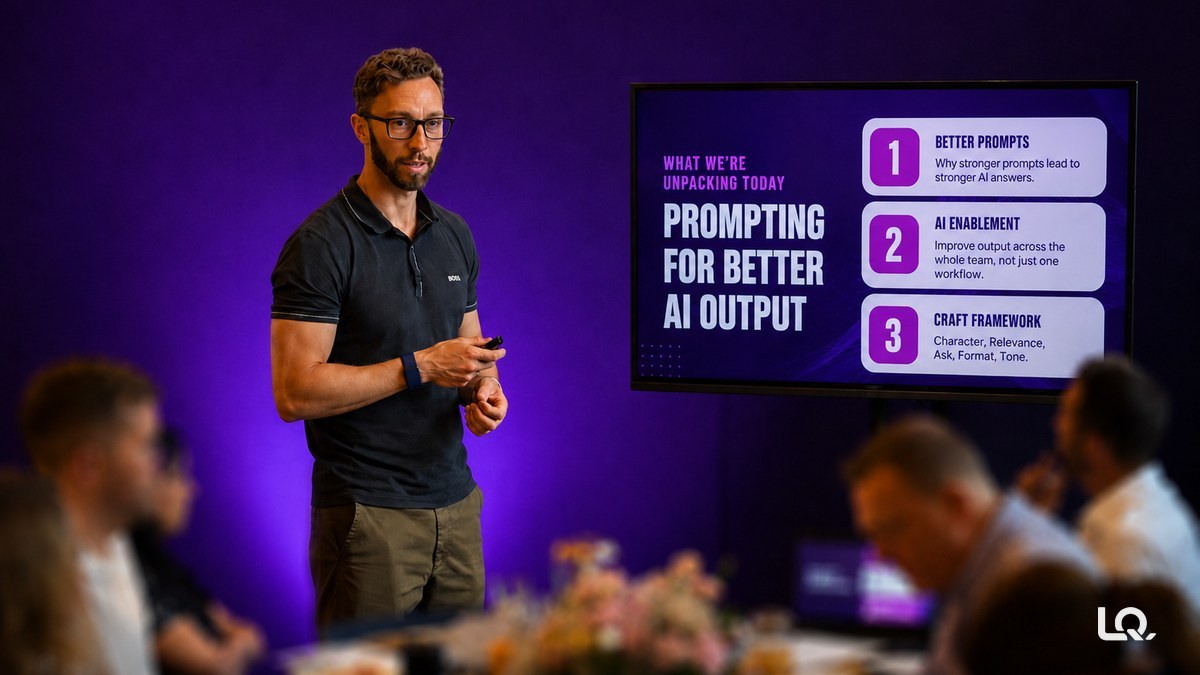
I recently delivered a talk in Macclesfield to a fantastic group who asked some brilliant questions throughout the session.
During the talk, I spent quite a bit of time discussing prompting. One of the big things I think businesses sometimes get wrong when it comes to AI is that they immediately go after the big, shiny workflow or transformation project.
These projects can cost thousands of pounds, take a huge amount of time and sometimes deliver a questionable return on investment. Often, they simply do not pan out in the way the business originally hoped.
Start With AI Enablement
The thing that is often overlooked is AI enablement across the wider business.
During the session, we talked about the importance of improving prompts. If you can help your entire organisation prompt more effectively, you could see a significant improvement across the business.
Rather than investing in one workflow that improves a single process by 10%, what would happen if you could train every employee and improve their output by 5 to 10% through better prompting?
That improvement could be applied across hundreds of everyday tasks, from writing emails and analysing information to developing ideas and preparing reports.
Introducing the CRAFT Prompting Framework
In the session, I explored a tool I created called CRAFT, which focuses on improving the quality of your prompts.
You can enter a basic prompt, and the tool will challenge and question you to help develop it across five areas:
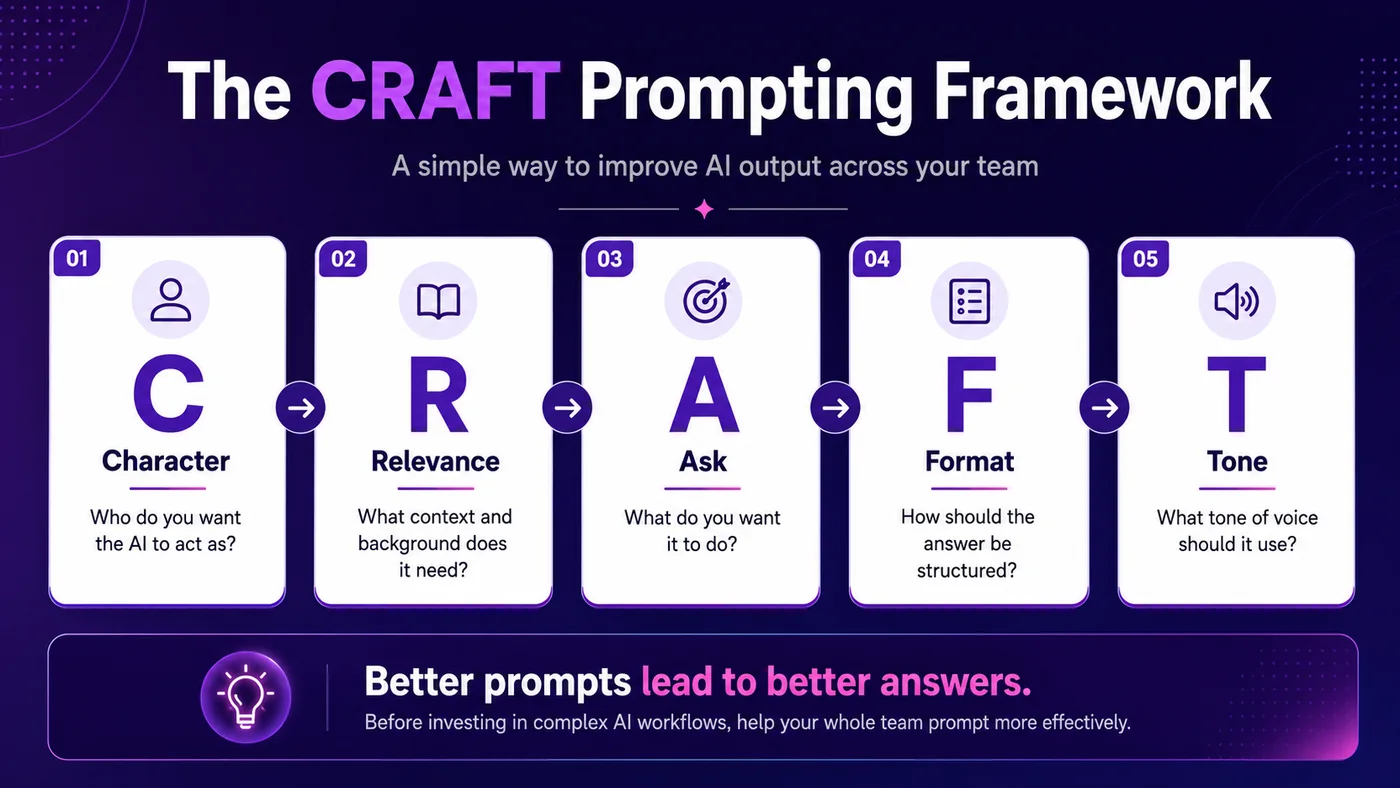
Character
Who do you want the AI to act as? What experience, expertise or perspective should it bring to the task?
Relevance
What background information and context does the AI need to understand?
Ask
What do you actually want it to do?
Format
How would you like the answer to be structured and presented?
Tone
What tone of voice do you want the output to use?
The tool works through this prompting process with you, helping you turn an initial idea into a clearer and more detailed instruction.
Fundamentally, if you enter a very generic and basic prompt, you are likely to receive a fairly generic and basic answer.
AI tools are getting better at understanding us and tailoring their responses based on their previous interactions with us. However, providing the right context is still one of the most reliable ways to achieve a stronger outcome.
GPT users can test the CRAFT tool here: CRAFT: The Perfect Prompt.
Do You Need to Use the Tool Every Time?
One of the questions that came up during the session was: do I need to use the CRAFT tool, or can I just do it myself?
Of course, you can do it yourself.
The CRAFT tool is not there to suggest that it is the only way to write a good prompt. What it does is help people understand the importance of a better prompt and quickly demonstrate what a stronger prompt can look like.
It can be particularly helpful when introducing AI to a wider team. Rather than simply telling people to provide more context, it gives them a framework they can follow and practise.
I now find myself using the CRAFT tool relatively rarely. I would like to think that I have developed a better understanding of how to prompt effectively and how to give AI the context it needs to provide a stronger answer.
That is ultimately the aim. The framework helps you build the habit, but you should not need to rely on it forever.
A Simple First Step for Businesses
For businesses that are just starting with AI and do not quite know where to begin, prompting is a really simple first step.
There are hundreds of different AI tools, projects and potential workflows you could invest in. That number of options can make it difficult to know where to focus.
Improving the quality of your team’s prompts does not require a huge investment or a lengthy implementation project. However, it could improve both the quality and quantity of their output almost overnight.
Before investing thousands of pounds in a complicated AI workflow, it may be worth asking a much simpler question:
How effectively is your team using the AI tools they already have?
Happy prompting, and good luck!
Luke
[ AI in Action ]
Want this in the room with your team?
Bring the AI in Action session to your business, or start with an audit of where you really stand.
Explore services