
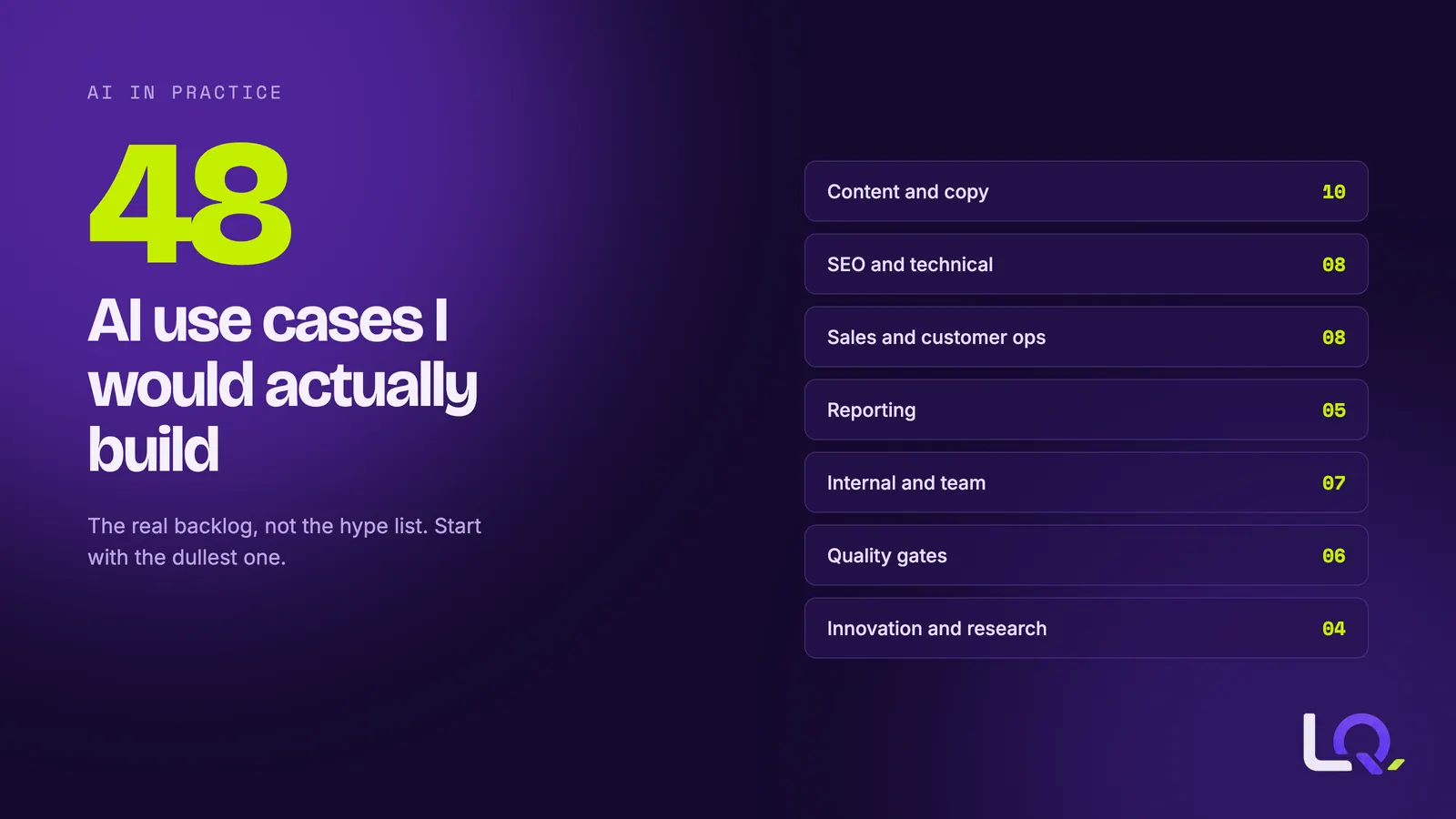
Every time I talk to a business about AI, the same question comes back: where do we start? The honest answer is not a transformation programme. It is a list of small, specific jobs that happen every week and that nobody enjoys doing. This is my list. Forty-eight of them, across content, SEO, sales, reporting, internal admin, quality control and research. None of them are moonshots, and that is exactly the point.
Most use case lists you find are aspirational. They are written by somebody who will never have to build any of it, so every item sounds equally easy and equally valuable. This one is a working backlog. It is ordered by category rather than by hype, and I have been fairly blunt at the end about which part of it I would start with and why.
If you have read my argument that better prompting beats an expensive workflow project, this is the companion piece. That post said do not chase the big shiny thing. This one shows you what the alternative actually looks like written down.
How to read this list
Before you get excited about any single item, run it through three questions. They will kill most ideas in about ten seconds, which is the fastest money you will save all year.
- Does it happen at least weekly? A brilliant automation of an annual task saves you almost nothing and costs you the same to build.
- Is there a right answer? If you cannot tell whether the output is good, you cannot ship it, and you will end up checking it by hand forever.
- Would you notice if it was wrong? The jobs where a quiet mistake sails straight through are the dangerous ones. Those need a person in the loop, not a bigger model.
One more thing, and it is the honest bit. Roughly half of this list is not really AI. It is ordinary automation with a single judgement step in the middle that used to need a person. That is not a criticism. It is the reason these work at all, and it is why they are achievable this quarter rather than next year.
Content and copy
The highest-volume work in most marketing teams, which means the smallest saving multiplies the fastest. It is also the category where the judgement step matters most, because a plausible wrong answer reads exactly like a right one.
- Brief-to-outline generator. Turns a brief from a stakeholder or customer into a structured content outline.
- Readability grader that scores a draft against a target audience level.
- Claim checker that flags stats and assertions needing a source.
- Keyword coverage checker against a target list.
- Meta title and description writer with length validation built in.
- Internal link suggester built from a site crawl.
- Repurposer. Blog to LinkedIn to email snippet to carousel copy.
- Duplicate and cannibalisation detector across a content library.
- Alt text generator for image batches.
- Plain-English rewriter for jargon-heavy drafts.
SEO and technical
My favourite category to automate, because the inputs are already structured. The model is not being asked to invent anything, it is being asked to read a large, boring file and tell you what changed and what to do about it.
- Crawl diff. What changed since the last crawl, prioritised by impact.
- Broken link and redirect chain reporter.
- Schema markup validator and generator.
- Core Web Vitals regression alert.
- SERP feature tracker for your target keywords.
- Competitor content change monitor. New pages, updated titles, quietly rewritten copy.
- Sitemap versus crawl reconciliation.
- Log file anomaly summariser.
Several of these are also how you keep an eye on whether your business is visible in AI answers, which is a question that did not exist three years ago and now comes up in every board conversation I sit in.
Sales and customer operations
The highest-value category on the list, and the one most teams skip because it feels less technical than SEO. It is where the money actually is.
- Inbound lead enricher and scorer writing straight into your CRM.
- Proposal first-draft builder from a discovery call transcript.
- Scope creep detector that compares delivered work against what was agreed.
- Renewal reminder with an account health summary attached.
- Meeting transcript to action items to tasks in whatever your team already uses.
- Customer email sentiment tracker. Early warning on accounts going quiet or cold.
- Case study drafter from campaign or project results.
- Pricing consistency checker across proposals.
Reporting
Nobody enjoys writing commentary. Everybody reads it. That gap is the whole opportunity.
- Monthly report narrator. Turns dashboard numbers into written commentary.
- Anomaly explainer. Why did traffic drop last Tuesday?
- Weekly analytics digest from GA4 and Search Console, emailed out.
- Budget pacing alert on ad accounts.
- Slide deck refresher that swaps in new numbers and checks the story still holds.
That last one is more interesting than it sounds. Plenty of recurring decks quietly stop being true when the numbers move, and nobody notices because the words did not change.
Internal and team
The unglamorous category, and the one with the fastest payback, because none of it needs a customer to sign anything off. You can start on Monday.
- Project hygiene bot. Stale tasks, missing due dates, unassigned work.
- Timesheet gap nudger.
- Weekly team digest built from your chat and project tool activity.
- Onboarding pack generator for new starters or new customers.
- Process doc staleness checker. Which policies nobody has touched since 2023.
- Interview note summariser that fills in the scorecard.
- Expense receipt categoriser.
Quality gates
The category I would build first. The argument for that is in the next section.
- Brand palette and font checker for exported decks and documents.
- Accessibility checker for landing pages.
- Link and UTM validator run before a campaign goes live.
- Pre-send email checker. Broken merge tags, missing unsubscribe, subject line length.
- Compliance phrase flagger. Guarantees, superlatives and claims that would not survive a regulator.
- Translation consistency checker for multilingual sites.
Innovation and research
The four that stop the other forty-four going stale.
- Tool and competitor news scanner with a weekly summary.
- Idea backlog scorer. Effort against impact, triaged.
- Prompt library regression tester. Does the new model still pass the old cases?
- Experiment logger that writes up results in a consistent format.
The regression tester deserves more attention than it gets. Model versions change underneath you, and a workflow that worked perfectly in March can quietly degrade in June with no error message and no alert. If you are going to depend on a prompt, test it like you would test code.
Where I would actually start
If you take one thing from this list, take this: start with a quality gate, not a generator.
It is the opposite of where almost everyone starts, and there are four reasons for it.
- A generator creates work. A checker removes it. Every draft an AI produces has to be read, corrected and approved by a person. Every check it runs is a job that person was already doing and no longer has to.
- A checker fails safe. If it misses something, you are exactly where you were before. If a generator gets something wrong and nobody catches it, you have published it.
- Nobody has to change how they work. Adoption is the hardest part of any of this, and a quality gate asks for no behaviour change at all. It sits at the end of a process that already exists.
- You get a number in week one. How many things it caught. That is the most useful sentence you can put in front of a finance director, and it is the reason your second project gets funded.
Pick the check that would have saved you the most embarrassment in the last twelve months. Most teams know instantly what that is.
The thing most businesses get wrong
Here is what I keep finding when I run AI readiness work inside organisations. The tools are already in the building. Almost everybody has an AI assistant, most of them use it every single week, and almost nobody has ever had it explained to them what it is meant to do for their specific job.
Licences bought. Purpose never issued.
That is not a technology problem and no amount of extra budget fixes it. It is a direction problem, and it is remarkably cheap to solve. A list like this one is a large part of the answer, because it turns "use AI" into forty-eight named jobs, and a named job is something a person can actually pick up on a Monday morning.
So take the list. Cross off everything that fails the three questions at the top. Of what survives, pick the dullest, most repetitive quality check you have, and build that one. It will not feel like the future. It will save somebody four hours a week, and it will be running by the end of the month, which is considerably more than most AI strategies can say.
If you want a view on where your own organisation actually stands before you pick, that is exactly what an AI readiness assessment is for.
Good luck, and start small.
Luke